
The feeling of being “stuck” is no longer just a personal grievance; it is a quiet crisis rippling through the Indian professional workforce. If you feel a sense of dread when looking at your degree, you aren’t alone. For many, the realisation hits hard a few years into the workforce: the degree you spent four years and lakhs of rupees pursuing lacks the economic viability or personal fulfilment you were promised.
This “degree regret” isn’t a failure on your part. It is the natural result of a legacy education system that prioritises rigid tracks over market foresight. But here is the good news: a degree is a static credential, whereas your employability is a dynamic state. The numbers tell a story we can no longer ignore, and by utilising the “Professional Pivot” framework, you can navigate the transition from a misaligned past to a high-growth, future-proof career.
1. The 86% Factor—Why Your Career Wasn’t Really Your Choice
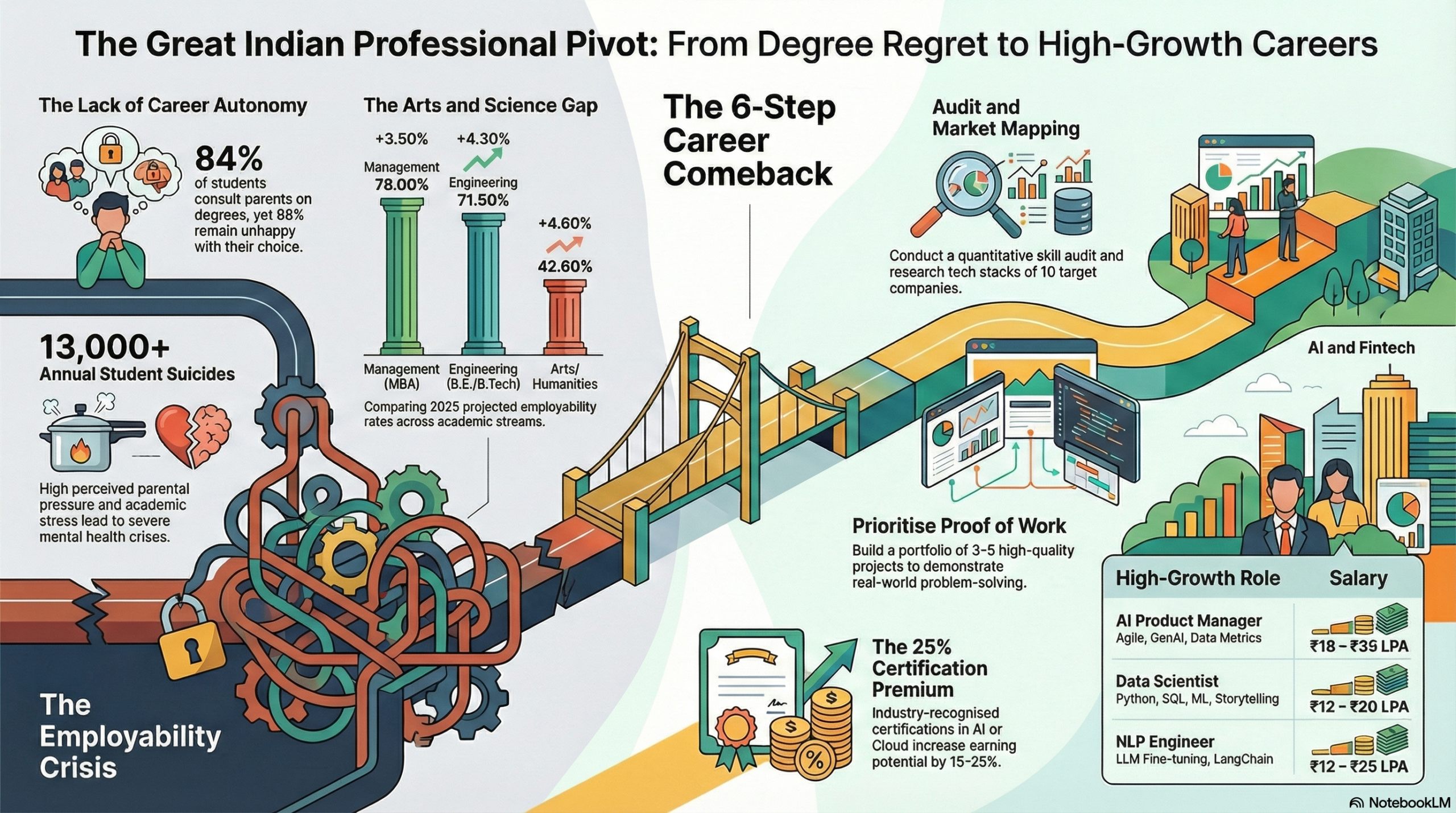
In India’s collectivistic culture, professional success is often treated as a reflection of family honor. This creates a “crisis of misalignment” where individual aptitude is sacrificed for societal prestige. The data is staggering: 86.0% of Indian adolescents experience high perceived parental pressure regarding their academic choices, with 84% consulting their parents before choosing a stream.
This inherited mandate often leads to a massive workforce of professionals trapped in roles that offer no personal resonance. The psychological toll of this pressure is a burden we must address with urgency:
2. The Employability Paradox—Credential vs. Competency
“Research published in the Indian Journal of Psychiatryreveals that over 30% of Indian adolescents suffer from anxiety and depression directly attributed to academic pressure. The gravity of this issue is further underscored by National Crime Records Bureau (NCRB) data, which reports that more than 13,000 students in India die by suicide every year, with academic stress being a primary contributor.”
With 68% of students reporting dissatisfaction with their academic stream, the pivot is more than an economic necessity—it is a mental health imperative.
The traditional belief that a degree equals a job has officially collapsed. While overall youth employability is projected to rise to 54.81% in 2025, there is a widening rift between those with a certificate and those with actual competency.
Comparative Employability Rates by Academic Stream (2024–2025)
| Academic Stream | 2024 Employability | 2025 Projected | Year-on-Year Change |
| Management (MBA) | 74.50% | 78.00% | +3.50% |
| Engineering (B.E./B.Tech) | 67.20% | 71.50% | +4.30% |
| MCA | 65.00% | 71.00% | +6.00% |
| B.Sc. (Science) | 52.00% | 58.00% | +6.00% |
| Arts/Humanities | 38.00% | 42.60% | +4.60% |
Notice the trend: roles in HR and digital marketing are seeing sharp drops in employability (falling to 39.9% and 41%) because they lack technical integration. Conversely, technical roles in AI and Machine Learning are surging.
Strategic Insight for Female Professionals: You must be particularly targeted in your re-skilling. While men’s employability is expected to rise to 53.5% in 2025, women’s employability is projected to decline to 47.5%. To counter this structural challenge, female professionals should leverage fields like Data Science and Product Management, where the gender gap is narrowing and technical proficiency creates a more level playing field.
3. The AI & Data Science Gold Rush is Real (and Quantifiable)
The Indian AI industry is projected to reach a market size of $28.8 billion by 2025 with a staggering 45% annual growth rate. This demand is creating high-paying roles that prioritize specialized skills over what you studied in 2018.
In today’s market, “Data Storytelling” has become a crucial requirement. It is no longer enough to run a model; you must be able to translate complex data insights into business impact and explain the “why” to non-technical stakeholders.
Top Skills Required for 2025 Roles:
- Foundational: Python, SQL, ML Basics
- AI Specialization: TensorFlow, PyTorch, LLM fine-tuning
- Infrastructure: AWS/GCP, MLOps, Spark, Airflow
- Core Metrics: A/B Testing, Data Metrics, GenAI tool proficiency
2025 Salary Benchmarks for High-Growth Roles
| Role | Core Responsibilities | Top Skills Required | Salary Range (LPA) |
| AI Product Manager | Strategy for AI features | Agile, Data Metrics, GenAI | ₹18 – ₹35 LPA |
| NLP Engineer | Human language systems | Hugging Face, LangChain | ₹12 – ₹25 LPA |
| Data Scientist | Trend discovery | Python, SQL, Data Storytelling | ₹12 – ₹20 LPA |
| ML Engineer | Model deployment | TensorFlow, PyTorch, MLOps | ₹10 – ₹22 LPA |
4. “Proof of Work” Trumps the Traditional Resume
A career switch is a fundamental professional transformation. To execute this successfully, I utilize a 6-Step Career Comeback Framework:
- Multi-Dimensional Skill Audit: Quantitative assessment of your current vs. target levels.
- Strategic Market Mapping: Identifying 10-15 target companies and their tech stacks.
- Precise Skill Gap Analysis: Prioritizing the “must-have” skills for hireability.
- Parallel Learning: Upskilling via stackable, industry-recognized certifications.
- Strategic Portfolio Development (The Core): Building tangible “Proof of Work.”
- Resume & LinkedIn Rebranding: Shifting from chronological history to functional impact.
Step 5 is your most powerful weapon. Recruiters in 2025 require tangible evidence. For Tech roles, this means GitHub repositories with clean code; for Product roles, it means Product Requirement Documents (PRDs); for Design, it means case studies showing user testing results.
The “Impact-Based Bullet” Formula
To make your transition credible, your resume must follow this structure: Action + Impact + Result + Relevance.
Example:“Optimized cross-channel campaigns that delivered 22% ROI growth within six months—transferring these analytical skills to a Data Analyst context.”
5. The “Conversion Course” Strategy for Non-Techies
If your original degree feels like a complete mismatch, you don’t necessarily need another four-year commitment. “Conversion Programs” in the UK and Ireland act as a professional “reset button,” allowing graduates from anydiscipline—be it Arts, Commerce, or legacy Engineering—to transition into technical fields in just 12 months.
ROI for UK/Ireland Conversion Tracks
| Field | Entry Requirements | Outcome Role | Approx. Tuition | Avg. Salary (GBP) |
| MSc Data Science | Degree in any discipline; Basic Math | Data Scientist | ₹16 L – ₹19.5 L | £45k – £55k |
| MSc Comp Sci | Degree in any discipline; 3.0 GPA/85% | Software Engineer | ₹15 L – ₹18.5 L | £38k – £45k |
| MSc Management | 0–2 years experience; Any background | Consultant | ₹22 L – ₹45 L | £35k – £52k |
| Law (GDL) | Non-law degree; English proficiency | Solicitor | ₹13 L – ₹17.5 L | £35k+ |
Conclusion: From Herd Mentality to Professional Agility
The “rat race” in India is fueled by a herd mentality—following a path because it is perceived as “safe” rather than because it aligns with market reality. Escaping the degree trap requires you to ask one hard question: Is your current path a result of your personal Ikigai (the intersection of what you love, what you are good at, and what the world pays for), or is it an inherited mandate?
A successful pivot follows a structured 6–18 month horizon:
- Months 1–2 (Audit Phase): Quantitative self-assessment and alignment of choices with your unique profile.
- Months 3–8 (Upskilling Phase): Targeted skill development, foundational certifications, and building “Proof of Work” projects.
- Months 9–12 (Rebranding Phase): LinkedIn optimization, market mapping, and aggressive networking.
- Months 13–18 (Transition Phase): Securing internships or bridging roles, refining your elevator pitch, and final job placement.
Your original degree is only a waste if you don’t use it as the catalyst for a more resilient, future-proof career. The time to pivot is now.
Ready to find your true calling? > If you’re still navigating the complexities of your career path, let’s find the way forward together. Reach out for personalised guidance at manjari@zhagaramacademy.com, or send us a message on WhatsApp at +91 8531824727.
For a deeper dive into your passion and purpose, join our Career Community or take our tailor-made career assessment test to get started today.